 ALMUTEM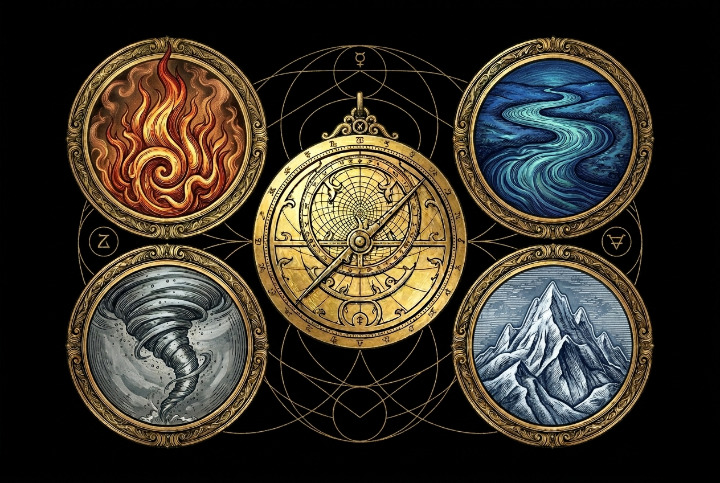
The four elements and temperaments in the natal chart
The idea that everything in the sublunar world is made from a combination of four elements — Fire, Earth, Air, and Water — comes from the pre-Socratic Greeks (Empedocles, 5th c. BCE) and survived intact through two thousand years of philosophy, medicine, and astrology. Aristotle refined it: each element results from pairing two primary qualities — hot or cold with dry or moist. Galen carried the doctrine into medicine (2nd c. CE) — the four humors of the body correspond to the four elements, and the balance between them governs health, disease, and temperament. Ptolemy, Galen’s contemporary, applied the same structure to the twelve signs.
In traditional astrology this shared scheme is not metaphor. It is the same system described from different angles. When a 17th-century astrologer read a chart, he judged the native’s complexion (temperament) the same way a physician would: by looking for the dominant qualities. The zodiac was simply another diagnostic instrument, and arguably the most precise one, because it works from date and time of birth without a physical examination.
The four primary qualities
Everything begins with two oppositions:
- Hot versus cold — active energy versus contraction.
- Dry versus moist — definition versus dispersion.
Pairing them yields four combinations:
- Hot + dry = Fire
- Cold + dry = Earth
- Hot + moist = Air
- Cold + moist = Water
Fire heats and divides. Earth cools and fixes. Air heats and disperses. Water cools and joins. This elementary grammar runs through everything that follows.
The twelve signs by element
The signs distribute themselves into four triplicities of three signs each, sharing the same element:
- Fire — Aries, Leo, Sagittarius
- Earth — Taurus, Virgo, Capricorn
- Air — Gemini, Libra, Aquarius
- Water — Cancer, Scorpio, Pisces
Within each triplicity the three signs share the same basic nature but express it in different modes — cardinal, fixed, or mutable. Cardinal Fire in Aries initiates; fixed Fire in Leo consolidates; mutable Fire in Sagittarius disperses.
The four humors and the four temperaments
Galenic medicine named four bodily humors — blood, yellow bile, black bile, phlegm — matching the four elements. The dominant humor defines the temperament:
- Sanguine (blood → Air): hot and moist. Sociable, lively, generous, expansive. Easily distracted; promises more than it delivers.
- Choleric (yellow bile → Fire): hot and dry. Decisive, fast, ambitious, quick-tempered. Impatient with obstacles; acts before thinking.
- Melancholic (black bile → Earth): cold and dry. Serious, reflective, persistent, conservative. Inclined to doubt and sadness; slow to trust.
- Phlegmatic (phlegm → Water): cold and moist. Calm, patient, loyal, contemplative. Hard to move; avoids conflict.
These four are not mutually exclusive boxes. Every person is a mixture, with one or two dominant temperaments and the others in lesser proportions. Most natives are “binaries” — sanguine-choleric, melancholic-phlegmatic, and so on — and the binary tends to describe the person more faithfully than a single pure type.
Computing temperament from the chart
This is what distinguishes an astrological diagnosis from any personality quiz. The method organizes into four blocs of factors, in descending order of weight:
I. Ascendant bloc (the most important — describes the body and base expression)
- Qualities of the Ascendant sign
- Qualities of the Ascendant’s ruling planet + qualities of the sign that planet occupies
- Planets in house I or conjunct the Ascendant (qualities of the planet)
- Planets in aspect to the Ascendant (qualities of the sign they occupy)
II. Moon bloc (metabolism and the sensory dimension)
- Qualities of the Moon’s sign + qualities of her lunar phase/quarter: 1st quarter (new moon → first quarter) = Hot + Moist; 2nd quarter (first quarter → full moon) = Hot + Dry; 3rd quarter (full moon → last quarter) = Cold + Dry; 4th quarter (last quarter → new moon) = Cold + Moist
- Qualities of the sign of the Moon’s dispositor
- Planets conjunct the Moon (qualities of the planet)
- Planets in aspect to the Moon (qualities of the sign they occupy)
III. Sun bloc (vitality — season only)
- Season of birth: spring (H+M), summer (H+D), autumn (C+D), winter (C+M)
- The Sun contributes only through the season, not its planetary nature — except when it is in house I or in aspect to the Ascendant or Moon, in which case it contributes the season’s qualities in that position
IV. Almuten Figuris bloc (synthesis)
- Qualities of the Almuten Figuris planet + qualities of the sign it occupies
Sum all contributed qualities (H = hot, C = cold, D = dry, M = moist). The dominant pair determines the temperament. When two temperaments are close, the binary is recorded.
Our calculator runs this method automatically.
Why this matters
Knowing your temperament changes how you read the rest of the chart. A sanguine with Mercury in Gemini lives his talkativeness very differently from a melancholic with the same placement: the first is expanding a natural quality; the second is straining against his own tendency to silence. The same astrological positions land in different ways depending on the temperamental medium that receives them.
For traditional doctrine, this is the first question to ask before any detailed reading: what kind of body and mind is receiving these planets? Modern astrologers usually skip this step and start interpreting planet by planet, aspect by aspect. Traditional astrology inverts the order: temperament first, structure next, details last. It is a different way of thinking, inherited directly from the 2nd-century physician’s consulting room.