 ALMUTEM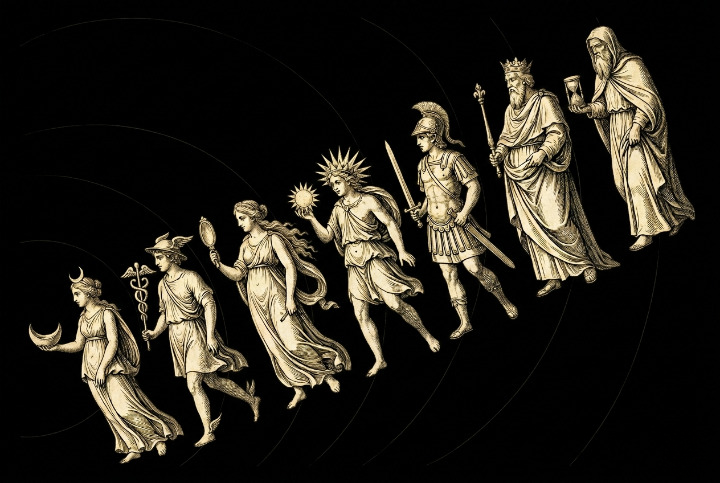
The seven classical planets — origin and meaning
Before the telescope (17th c.), astrology had two thousand years to build itself around exactly seven celestial bodies — the only ones visible to the naked eye that move against the fixed background of stars. The Greeks called them planētai, “wanderers”. The introduction of Uranus (1781), Neptune (1846), and Pluto (1930) reorganized modern astrology, but traditional astrology held to its base of seven. Not from nostalgia — from internal structure.
The seven
Each of the seven has a distinct nature, described by Ptolemy in terms of the four elemental qualities:
- Sun — hot and dry. Vitality, authority, will, what illuminates and gives identity. The symbolic heart of the chart.
- Moon — cold and moist. The body, what grows and diminishes, nourishment, childhood, instinct. Everything that flows and changes.
- Mercury — cold and dry (but mutable, taking on the nature of the planet he associates with). Thought, speech, commerce, the young.
- Venus — hot and moist (in a gentle proportion). Pleasure, beauty, art, affectionate bonds, fertility.
- Mars — hot and dry to excess. Initiative, iron, war, surgery, drive, anger.
- Jupiter — hot and moist in ideal measure. Expansion, abundance, law, philosophy, favorable fortune.
- Saturn — cold and dry to excess. Time, limit, weight, persistence, melancholy, loss.
Classical astrologers do not interpret these natures as characters in a cast; they interpret them as chemical mixtures. A Sun-Mars conjunction combines two hot and dry bodies — producing extreme heat, burning, fever. A Venus-Moon conjunction blends two moist bodies — generating receptivity, sensuality, flow. The doctrine of elements makes interpretation predictable: you know the qualities, you know what comes out of the combination.
Good, bad, neutral
Tradition sorts the planets into three moral groups:
- Benefics — Jupiter (greater benefic), Venus (lesser benefic). Their effects tend toward the favorable.
- Malefics — Saturn (greater malefic), Mars (lesser malefic). Their effects tend toward the unfavorable.
- Neutrals — Sun, Moon, Mercury. Effects depend on context.
This classification is not arbitrary; it reflects the elemental proportions. Jupiter (moderate hot and moist) matches the healthiest human mixture. Saturn (extreme cold and dry) matches the condition that kills. This is not moral judgment — it is medical prognosis applied to symbols.
Modern astrology has tended to abolish this classification as “negative”. Tradition replies that ignoring the difference between a Jupiter square and a Saturn square impoverishes the reading — it does not make both vaguely “growth challenges”. The first is an excess to be managed; the second is a loss to be lived through.
Sect — diurnal and nocturnal
Each planet belongs to a sect: the diurnal (Sun, Jupiter, Saturn) or the nocturnal (Moon, Venus, Mars). Mercury is neutral — he takes the sect of the hemisphere where he sits relative to the Sun.
A planet of its own sect (a diurnal planet in a daytime birth; a nocturnal planet in a nighttime birth) acts more easily and expresses its nature better. Mars in a nighttime birth is less violent; in a daytime birth more aggressive and accident-prone. The same with the other malefics: Saturn is heavier by day; Mars is more dangerous by day.
This sect distinction is fundamental in Hellenistic and medieval astrology and was lost in most modern practice. Robert Hand recovered it in Night and Day (1995), one of the central texts for understanding why tradition reads the same chart so differently.
What about the trans-Saturnians?
Our calculator displays Uranus, Neptune, and Pluto in their zodiacal position for visual completeness — but does not use them for doctrinal judgments. They form no counted aspects, rule no houses, do not enter the Almuten Figuris scoring. The reason is simple: they were discovered after the traditional doctrine was formed, and any subsequent attribution is modern interpretation, not tradition.
This does not make them irrelevant to 20th-century psychological astrology — it makes them irrelevant to the traditional reading we offer. If your preferred tradition is different, other services emphasize these planets. Our decision is one of doctrinal coherence.